- Healthcare 150
- Posts
- 69% of Healthcare Orgs Are Betting on AI: Here’s What Comes Next
69% of Healthcare Orgs Are Betting on AI: Here’s What Comes Next
Hospitals are moving beyond experimentation as AI begins reshaping care delivery.


Good morning, ! This week we’re unpacking Europe’s healthcare efficiency playbook, the AI power shift toward generative models, rising data-driven enforcement around kickbacks and financial relationships, and the surge in MedTech innovation across Europe’s patent landscape.
Want to advertise in Healthcare 150? Check out our ad platform, here.
Know someone in the healthcare space who should see this? Forward it their way. Here’s the link.
— The Healthcare150 Team
DATA DIVE
Europe’s Efficiency Playbook: Automation, Outpatient Care, and the Infrastructure Bet
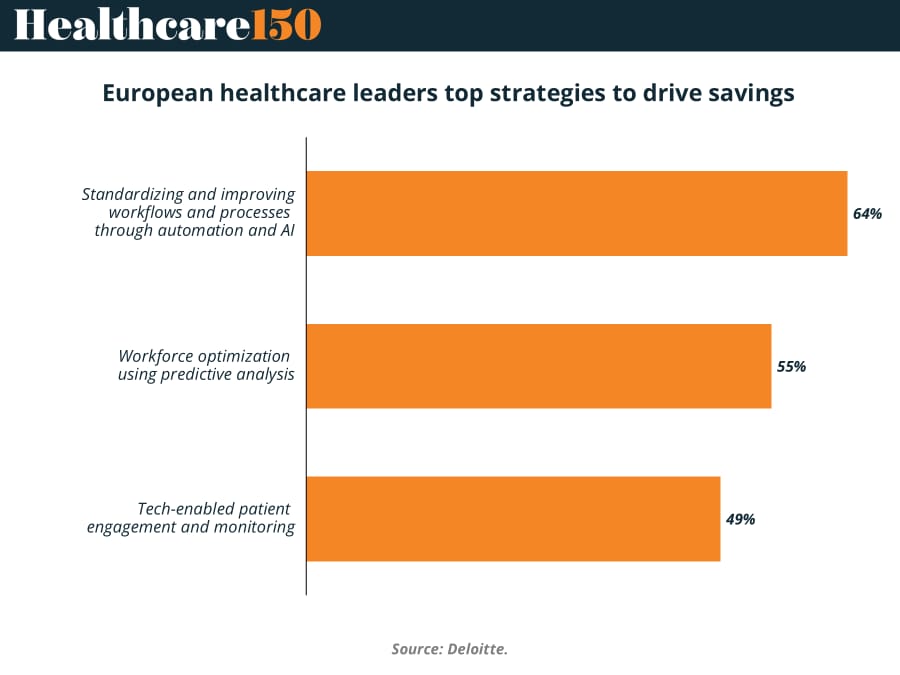
European healthcare leaders are responding to financial pressure with structural efficiency strategies rather than blunt cost cutting. The data shows 64% of leaders prioritizing workflow automation and AI to reduce administrative friction, while 55% are focusing on predictive workforce optimization. Another 49% are investing in technology enabled patient engagement and monitoring. The signal is clear. Operational redesign has become the primary lever for cost control.
Technology budgets reinforce this shift toward infrastructure. Core systems capture 16% of tech spending, followed by digital health platforms at 15%, with AI, cybersecurity, and data modernization each receiving 14%. Investment is spreading across foundational capabilities rather than concentrating in experimental tools. Providers appear focused on building the digital backbone required for long term efficiency.
Spending patterns across Europe also suggest a gradual rebalancing of care delivery. Hospitals account for 37% of EU health expenditure on average, compared with 26% for ambulatory care and 38% for other providers. Financing remains largely collective, with compulsory insurance covering 52% of spending and governments 28%. The takeaway is that Europe is pursuing sustainability through operational transformation, digital infrastructure, and a slow shift away from hospital centric care.
HEALTHTECH CORNER
The AI Power Shift
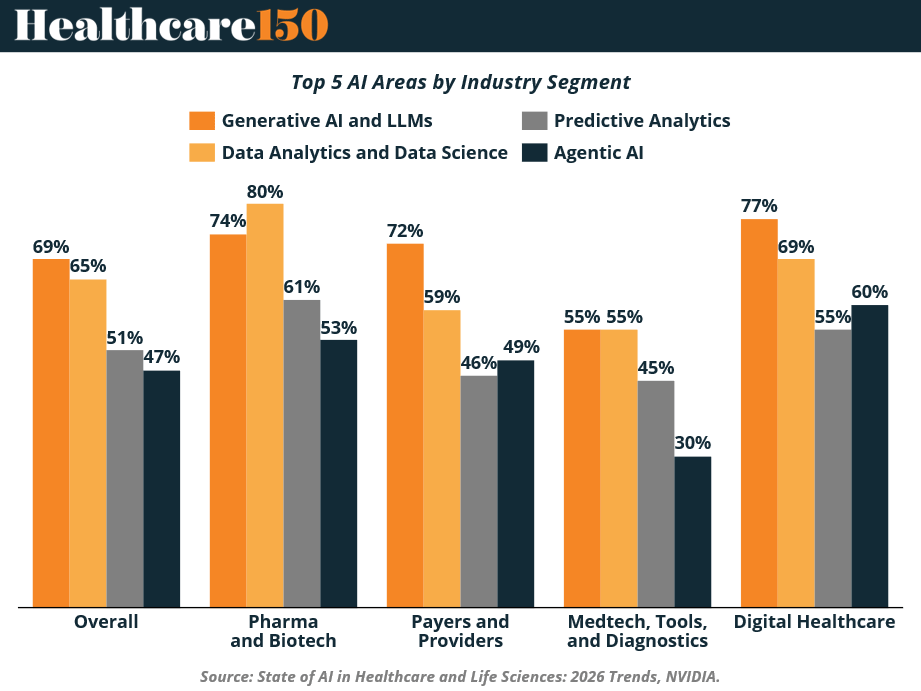
For years, Predictive Analytics and Data Science carried the healthcare AI conversation. In 2025, Generative AI just took the top seat.
New survey data shows 69% of healthcare and life sciences organizations now prioritize Generative AI and LLMs as their primary AI workload — a 15-point jump year-over-year, pushing it ahead of Data Analytics (65%). Meanwhile, Predictive Analytics (51%) and Agentic AI (47%) are gaining traction as organizations explore more autonomous systems.
The sector breakdown is telling. Pharma and Biotech lean heavily into data analytics (80%) and Generative AI (74%), reflecting the data-intensive nature of drug discovery. Payers and Providers are betting on Generative AI (72%) for workflow automation, while Digital Health companies are pushing into Agentic AI (60%).
The big picture: healthcare AI is moving from analyzing data to generating insights and automating decisions. (More)
PRESENTED BY JUNIPER SQUARE
New fund formats call for a new operating model: fund operations partner.

Our report on the rise of new fund formats shows a clear shift: operating cadence is increasing, investor workflows are getting more complex, and expectations are moving toward to “always-on.”
That’s why leading PE firms are shifting to a fund operations partner model: one system of record + embedded expertise to run fundraising, investor operations, reporting, and administration with consistent data.
Juniper Square combines purpose-built software + expert fund administration services into a single connected operating model, delivering clearer visibility, fewer failure points, and a modern investor experience.
Read the full breakdown in the report.
Supporting our sponsors supports our free newsletters. Please support our sponsors!
COMPLIANCE CORNER
Data-Driven Enforcement Sharpens Focus on Kickbacks and Improper Financial Relationships
In 2024, federal and state regulators, led by the Department of Justice (DOJ) and HHS-OIG, have escalated data-driven enforcement targeting fraud, waste, and abuse related to the Anti-Kickback Statute (AKS) and Stark Law. The enforcement landscape now aggressively probes kickbacks, inducements, self-referrals, and improper financial arrangements by leveraging advanced analytics to identify billing irregularities and aberrant provider patterns.
Key trends include a surge in False Claims Act (FCA) cases, particularly qui tam suits fueled by whistleblowers receiving significant recoveries. DOJ settlements in 2024 have tackled complex kickback schemes disguised through vendor contracts or indirect benefits. Concurrently, CMS and HHS-OIG's Medicaid Fraud Control Units have intensified investigations of provider fraud and patient abuse, reinforcing state-federal partnerships.
Why it matters: The enforcement shift underscores that financial relationships in healthcare are under sharper scrutiny than ever, with regulators keen on uncovering subtle inducements and self-referral violations. Organizations face heightened exposure not only from traditional kickback arrangements but also from indirect or non-monetary incentives facilitated through third parties.
Bottom line: Healthcare leaders must prioritize rigorous oversight of all financial relationships and deploy robust data monitoring systems. Compliance programs require continuous adaptation to dynamic enforcement priorities grounded in analytics. Proactive identification and remediation of potentially suspect arrangements are essential to mitigate escalating civil and criminal risks. (More)
COMPETITIVE LANDSCAPE SNAPSHOT
TREND TO WATCH
MedTech IP Momentum in Europe
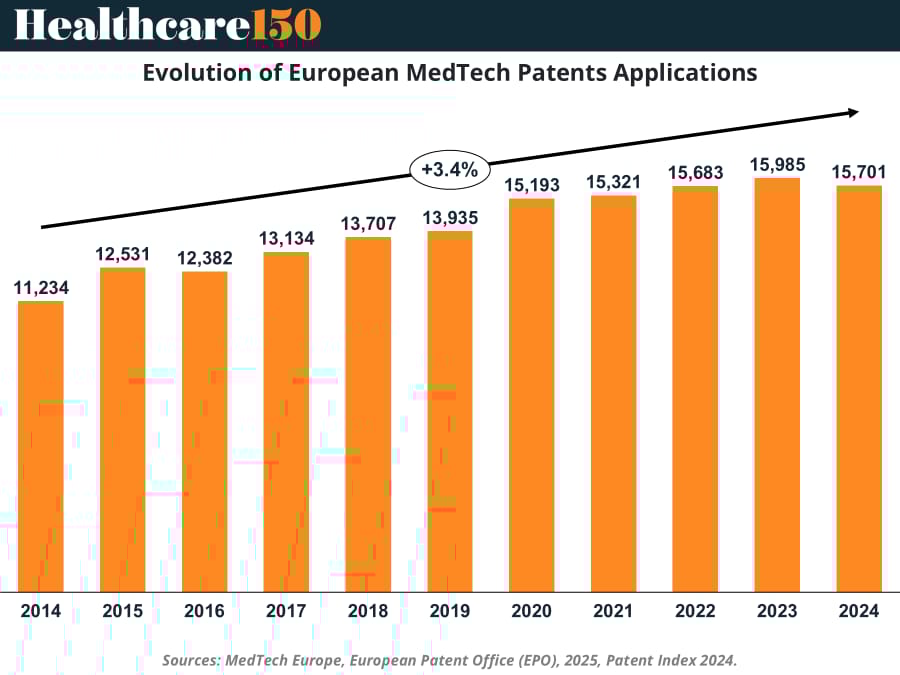
European MedTech patent applications continue to show steady long-term expansion. According to EPO Patent Index 2024 data, filings increased from 11,234 in 2014 to 15,701 in 2024, representing an average 3.4% annual growth over the decade. The trajectory highlights sustained innovation activity across medical devices, diagnostics, and digital health technologies. Although applications eased slightly from the 2023 peak (15,985), overall momentum remains strong.
For industry leaders, the data reinforces Europe’s role as a key innovation hub in healthcare technology and underscores the strategic importance of intellectual property as competition intensifies across the global MedTech landscape. (More)
“It is health that is real wealth and not pieces of gold and silver.”
Mahatma Gandhi