- Healthcare 150
- Posts
- $44B Telehealth Boom + Pharma Repricing Shock
$44B Telehealth Boom + Pharma Repricing Shock
Today we’re unpacking the widening margin gap across healthcare, Big Pharma’s repricing moment, Gilead’s $5B push into ADCs, and Brazil’s evolution into a digital health powerhouse.

Good morning, ! Today we’re unpacking the widening margin gap across healthcare, Big Pharma’s repricing moment, Gilead’s $5B push into ADCs, and Brazil’s evolution into a digital health powerhouse.
Want to advertise in Healthcare 150? Check out our ad platform, here.
Know someone in the healthcare space who should see this? Forward it their way. Here’s the link.
— The Healthcare150 Team
MICROSURVEY
Margin Check: Healthcare Is Splitting Fast
Healthcare margins are no longer moving in sync, and the latest survey makes that clear. At the surface, the sector looks balanced, with 38% reporting margin expansion, 36% contraction, and 26% stability over the past 12 months. That headline, however, hides a sharp divergence across business models.
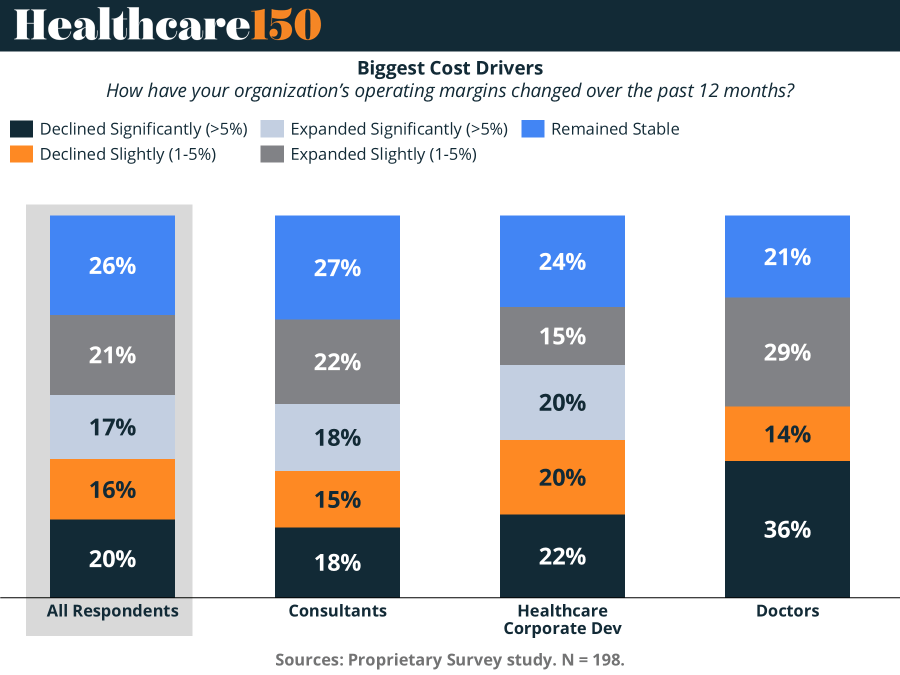
The pressure is most visible among physicians, where 50% report margin decline, including 36% seeing significant deterioration, while only 29% report slight expansion and 21% remain stable. The drivers are familiar but persistent: elevated labor costs, limited pricing flexibility, and administrative burden that continues to scale faster than revenue. In contrast, consultants show a far more resilient profile, with 40% reporting margin expansion versus 33% contraction, and only 18% experiencing significant declines, supported by flexible cost structures and stronger pricing leverage.
Corporate healthcare falls in between, with 42% reporting contraction and 35% expansion, reflecting both the benefits of scale and continued exposure to operating cost pressure. The implication is straightforward: margin performance now tracks proximity to labor-intensive care delivery. For investors, this is no longer a broad sector story. It is a question of model exposure and execution discipline. (More)
HEADLINE OF THE WEEK
US Expands Medicare Drug Price Controls:
Big Pharma’s Blockbuster Model Gets Repriced

What Happened
The U.S. added a new wave of blockbuster drugs to Medicare price negotiations under the IRA, expanding beyond last year’s initial list. The drugs span major revenue categories and now include assets earlier in their lifecycle than expected. Estimated price cuts: 25–60%.
Why It Matters: This is the shift from policy rollout → real economic impact. Pricing pressure is now systematic and predictable, not episodic.
Pharma response is already clear:
Pivot to orphan + biologics (protected economics)
Accelerate portfolio turnover
Lean into M&A to sustain pipelines
At the same time, weaker U.S. pricing power raises the importance of ex-U.S. markets.
Investor Take: he model is changing: high-margin annuity → semi-regulated cash flow. Implications: multiple compression, steadier but lower returns, higher policy sensitivity. (More)
PRESENTED BY JUNIPER SQUARE
Stop adding more tools or service providers. Get the best of both with a fund operations partner.

The LP experience can make or break fundraising because investors remember how it feels to work with your firm: onboarding, responsiveness, reporting, and the confidence they have in the numbers.
That experience is only as strong as the operating model behind it. When fund and investor data live across disconnected systems, delays and inconsistencies show up fast.
Juniper Square is the fund operations partner for PE GPs, combining software + fund administration services built on a common data foundation. That means fewer failure points, clearer visibility across investor workflows, and a modern investor experience powered by a single source of truth.
Book a demo to see how a fund operations partner
DEAL OF THE WEEK
Gilead Loads Up on ADC Firepower
Gilead Sciences is acquiring Tubulis for up to $5bn ($3.15bn upfront + $1.85bn milestones), doubling down on the increasingly crowded—and lucrative—antibody-drug conjugate (ADC) space.
Why it matters: This is less about a single asset and more about platform + pipeline. Tubulis brings TUB-040, a NaPi2b-targeting ADC in Phase 1b/2 for ovarian cancer and NSCLC, plus a next-gen linker-payload technology designed to improve precision delivery.
Zoom in: ADCs are having a moment, but differentiation is everything. Tubulis’ Tubutecan platform aims to widen the therapeutic window—translation: kill tumors, spare patients.
The bottom line: Gilead isn’t just buying assets—it’s buying tools to build more assets, faster. (More)
REGIONAL FOCUS
Brazil’s Telehealth Scale Is Converting Into Infrastructure
Brazil is moving from telehealth adoption to system-level integration. A $12.4B digital health market in 2025 is projected to reach $44B by 2034, implying a 15.3% CAGR. This is not just growth. It reflects a structural response to access gaps across a 200M+ population with uneven provider distribution.
What differentiates Brazil is infrastructure readiness. With 270M mobile subscribers and ~84% internet penetration, digital delivery is already viable at national scale. Policy is now catching up. The National Health Data Network and a BRL 23B AI investment plan are shifting telemedicine from point solutions to interoperable platforms.
Capital is following maturity. Healthtech funding rose 37.6% to $253.7M in 2024, despite fewer deals, signaling a pivot toward scaled, later-stage assets. Brazil captured 64.8% of regional investment, reinforcing its role as Latin America’s primary digital health hub.
Why this matters now: Brazil is no longer an emerging market telehealth story. It is becoming a test case for whether large, fragmented systems can operationalize AI-enabled care at scale. Execution risk remains high, but so does platform-level upside. (More)



"There is only one boss. The customer. And he can fire everybody in the company... simply by spending his money somewhere else"
Sam Walton