- Healthcare 150
- Posts
- What Will Matter Most for Successful Healthcare M&A in This Cycle?
What Will Matter Most for Successful Healthcare M&A in This Cycle?
In a market defined by higher rates, tighter capital, and increased regulatory scrutiny, healthcare M&A is no longer just about finding the right asset — it’s about managing complexity after the deal closes
To better understand where the real pressure points are, we asked 420 investors, operators, corporate development leaders, and clinicians a simple question: What will matter most for successful healthcare M&A in the current cycle?
The results reveal a fragmented but deeply insightful picture of how different stakeholders are thinking about risk.
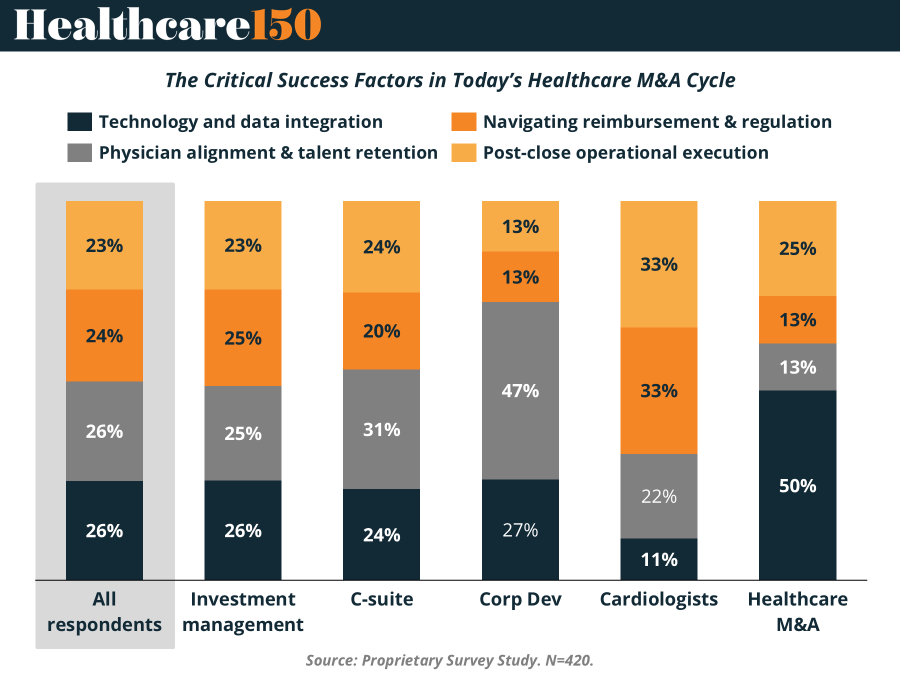
At the highest level, there is no single dominant answer. Among all respondents, priorities were almost evenly distributed across the four themes: technology and data integration (26%), physician alignment and talent retention (26%), navigating reimbursement and regulation (24%), and post-close operational execution (23%). That near-even split signals something important. This cycle is not defined by one bottleneck — it is defined by interconnected operational challenges. Healthcare M&A has become multidimensional, and success requires strength across several fronts simultaneously.
When we break the data down by audience, the contrasts become more pronounced.
Investment professionals see a three-sided risk equation. Technology integration, physician alignment, and reimbursement pressures all rank nearly equally among investment management respondents. That reflects how investors underwrite deals today: margin sustainability depends just as much on retaining clinical talent as it does on integrating systems or protecting payer economics. In this environment, underwriting assumptions are far more sensitive to operational friction than they were in the low-rate era.
Operators inside the business, however, show clearer conviction. Among C-suite leaders, physician alignment and talent retention (31%) emerges as the top priority. Corporate development teams are even more decisive, with 47% identifying physician alignment as the single most important factor for success. This is a striking signal. For those closest to integration, the biggest risk is not financial engineering or regulatory noise — it is human capital. If physicians disengage, reduce productivity, or leave, value creation stalls immediately. In roll-up strategies especially, retention risk becomes valuation risk.
Clinicians themselves tell another story. Cardiologists in our survey split their top concern evenly between navigating reimbursement (33%) and post-close operational execution (33%), while placing much less emphasis on technology integration (11%). From the physician perspective, economic stability and operational clarity matter more than systems architecture. They want assurance that revenue cycle performance will improve, not deteriorate, and that operations will become smoother rather than more bureaucratic. Technology is only valuable if it translates into tangible workflow and financial benefits.
Meanwhile, healthcare M&A professionals lean heavily toward technology and data integration (50%) as the defining factor. This suggests a growing recognition that modern healthcare platforms win on data. As margin compression intensifies and value-based care expands, the ability to integrate EMRs, unify analytics, and extract actionable insights becomes a strategic differentiator. Technology is no longer a back-office function — it is central to cost control, clinical optimization, and payer negotiations.
Taken together, the survey paints a clear picture of the current cycle. Healthcare M&A is no longer primarily a capital markets exercise. It is an execution challenge. Investors must underwrite operational durability. Operators must secure physician engagement. Clinicians demand reimbursement stability and smoother workflows. Dealmakers see technology as the connective tissue that ties it all together.
In today’s market, value is not created at signing. It is created — or destroyed — in the months that follow.