- Healthcare 150
- Posts
- The AI-Driven HealthTech VC Trend
The AI-Driven HealthTech VC Trend
Why Healthcare Venture Capital Has Become a Barbell Market
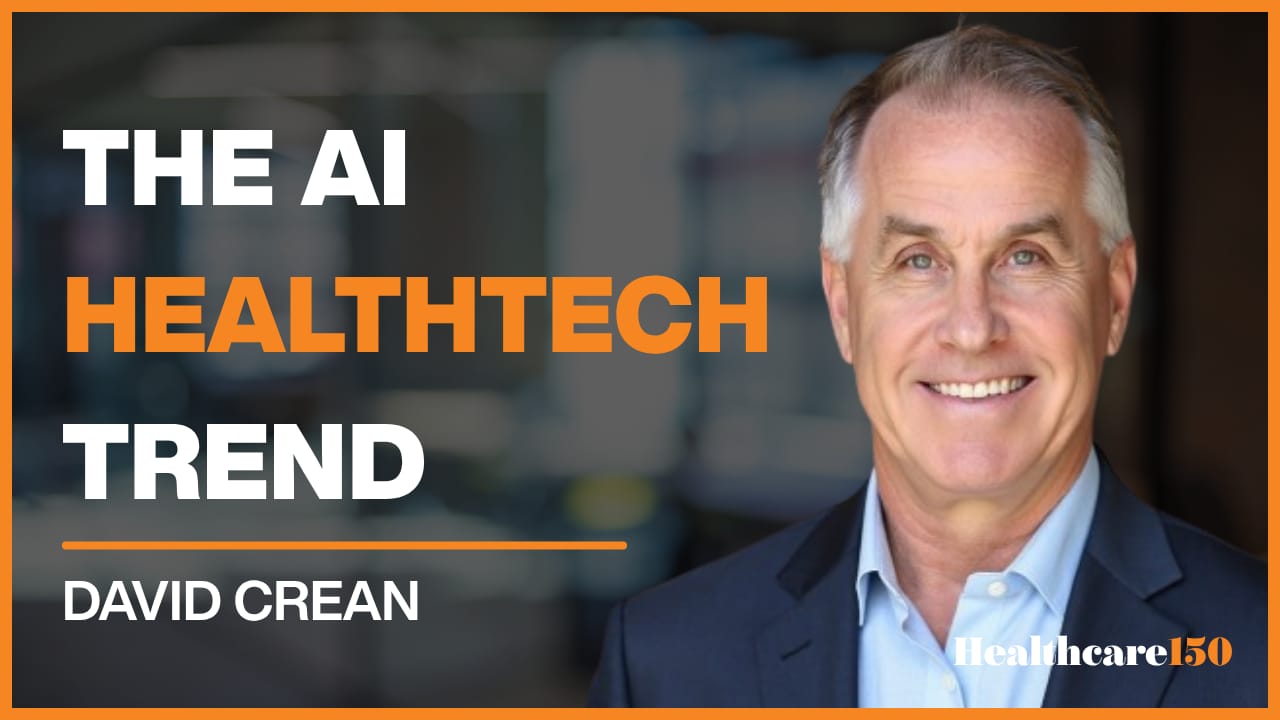
Few people are better positioned to explain the current transformation in healthcare venture capital than David H. Crean. A healthcare and life sciences executive with deep experience across strategic M&A advisory, venture capital, investment banking, investor relations, and corporate development, Crean brings both operating and transactional perspective to the table. He currently serves as Chief Business Officer at MediciNova, sits on boards, and is widely recognized as a speaker, author, and mentor in the sector. He is also the Founder and Managing Partner of Cardiff Advisory LLC, a strategic M&A advisory and valuation firm focused exclusively on the healthcare and life sciences industries. That combination of boardroom, capital markets, and dealmaking expertise makes his perspective especially valuable at a moment when AI is reshaping where healthcare dollars flow—and where they no longer do.
In our recent expert call, Crean laid out a clear thesis: healthcare venture capital is no longer operating in a balanced market. Instead, it has become a “barbell market,” where capital clusters at the extremes while the middle is being squeezed out.
According to Crean, the roots of this structural shift go back to the 2021 funding boom. That period was fueled by near-zero interest rates, abundant liquidity, and an investment environment in which, as he put it, “every story became fundable.” Companies with limited commercial readiness, uncertain paths to profitability, or immature data were still able to raise substantial private rounds or even access the public markets. In effect, the middle of the market was artificially expanded by cheap capital.
When rates rose, that structure broke. Healthcare was especially vulnerable because of its inherently longer commercialization timelines, reimbursement complexity, and regulatory risk. As public market valuations compressed, private market valuations had to reprice as well. That repricing hit mid-stage companies particularly hard. Investors pulled back from businesses that lacked either elite breakout potential or early-stage optionality, leaving a large swath of the market stranded between those poles.
This is where AI enters the picture.
Crean argued that the current wave of AI investment in healthcare is not simply hype. In many cases, the capital concentration is rational. AI is addressing genuine structural inefficiencies across the sector—from drug discovery timelines to clinical trial design, patient recruitment, administrative workflow optimization, and physician decision support. In his view, AI is not merely a “feature layer” in healthcare; it has the potential to become part of the sector’s new operating system.
That is why such a large share of healthcare VC is flowing into AI-enabled companies. Investors see the possibility of compressing development timelines, improving workflow efficiency, and reducing costs in a sector that has historically struggled with all three. But Crean was equally clear that real value and capital misallocation can exist at the same time.
The issue is not that capital is flowing into AI. The issue is that too much of it can become undiscriminating.
A company that simply adds “AI-enabled” to its pitch deck no longer stands out. Sophisticated investors are now looking much deeper: they are evaluating model performance, training data quality, integration into real clinical workflows, and resilience under stress. In other words, real AI diligence has arrived. The winners will be companies with defensible data assets, meaningful product integration, and measurable outcomes. The losers will be those relying on narrative without substance.
That distinction is exactly what is creating what Crean described as the market’s current “dead zone.” Mid-sized companies and rounds are not disappearing because capital has vanished entirely. They are disappearing because the bar for investment has changed. Businesses that sit in the middle—neither category-defining AI leaders nor seed-stage optional bets—must now prove much more.
Crean highlighted three non-negotiable proof points that investors increasingly require.
First, investors want real-world clinical or economic evidence, not just pilot results or conceptual validation. The market is demanding independently validated outcomes and clear proof that a product improves care, lowers costs, or both.
Second, companies must show a credible reimbursement and revenue model. Clinical promise alone is no longer enough. Investors want to know who will pay, at what price, and how the business becomes commercially scalable. In Crean’s words, investors want to fund businesses, not experiments.
Third, AI companies need to demonstrate true defensibility. That means articulating what proprietary data they own or control, why that data matters, and why competitors cannot easily replicate it. Simply plugging a generic AI layer into a healthtech product is not a moat. Exclusive access to longitudinal patient data, health system partnerships, or continuous clinical feedback loops may be.
Looking ahead, Crean does not believe the current barbell structure is fully permanent, but he also does not expect a return to the excesses of 2021. His base case is that the middle of the market does come back—partially—as valuations normalize, investor confidence rebuilds, and more AI-enabled healthcare companies begin producing consistent real-world performance data. He sees that as the most likely path.
Still, the timeline matters. For the middle to re-emerge in a durable way, the market will need more outcome data, more regulatory clarity, and stronger proof that AI-driven healthcare solutions are not just more efficient, but genuinely better and economically sustainable at scale.
That may take time. But if Crean is right, the next major opportunity in healthcare venture capital will not come from indiscriminate AI enthusiasm. It will come from identifying the companies that can bridge the gap between clinical credibility, commercial viability, and true AI defensibility.
Disclosure: Cardiff Advisory LLC is an M&A, strategic advisory, and valuation firm focused on the Healthcare and Life Sciences sectors. Securities products and investment banking services are offered through BA Securities, LLC, Member FINRA/SIPC. Cardiff Advisory and BA Securities, LLC are separate, unaffiliated entities.
Subscribe to David`s Insights HERE.