- Healthcare 150
- Posts
- AI in Healthcare
AI in Healthcare
Market Evolution, Adoption Dynamics, and Strategic Implications for a $600B+ Opportunity
I. Introduction
Artificial intelligence is no longer an emerging capability in healthcare—it is rapidly becoming the operating system of modern care delivery. What began as a set of experimental tools for data analysis and automation is now evolving into a foundational layer that underpins clinical decision-making, operational efficiency, and patient engagement at scale.
Healthcare, historically constrained by fragmented data, workforce shortages, and rising costs, is uniquely positioned to benefit from AI’s ability to transform complexity into actionable insight. Today, AI systems are augmenting clinicians in diagnostics, enabling earlier disease detection, streamlining administrative workflows, and unlocking new pathways for personalized medicine. From radiology and drug discovery to virtual care and hospital operations, AI is expanding the boundaries of what healthcare systems can achieve.
This transformation is being accelerated by the convergence of three structural forces: the exponential growth of healthcare data, significant advancements in machine learning and generative AI capabilities, and increasing financial and operational pressure on global health systems. Together, these dynamics are shifting AI from a productivity tool to a strategic necessity.
At the same time, the market is entering a phase of rapid scale. With adoption expected to more than double by the end of the decade and market size projected to exceed $600 billion by 2034, AI is transitioning from fragmented pilots to enterprise-wide deployment across the healthcare ecosystem.
This report explores that transition. It examines the evolution of the AI healthcare market, the key drivers accelerating adoption, regional dynamics shaping global growth, and the emergence of generative AI as a high-impact force. It also assesses the structural challenges—including regulation, data privacy, and workforce readiness—that will define how quickly and effectively AI delivers on its promise.
Ultimately, the question is no longer whether AI will transform healthcare—but how fast, how broadly, and who will capture the value.
II. AI in Healthcare Market Size
The scale of AI in healthcare is no longer theoretical—it is compounding rapidly into one of the largest technology-driven markets globally. From an estimated $36.9B in 2025, the market is projected to grow nearly 17x to over $613B by 2034, reflecting one of the fastest expansion curves across any major industry.
This growth is not linear—it’s exponential.
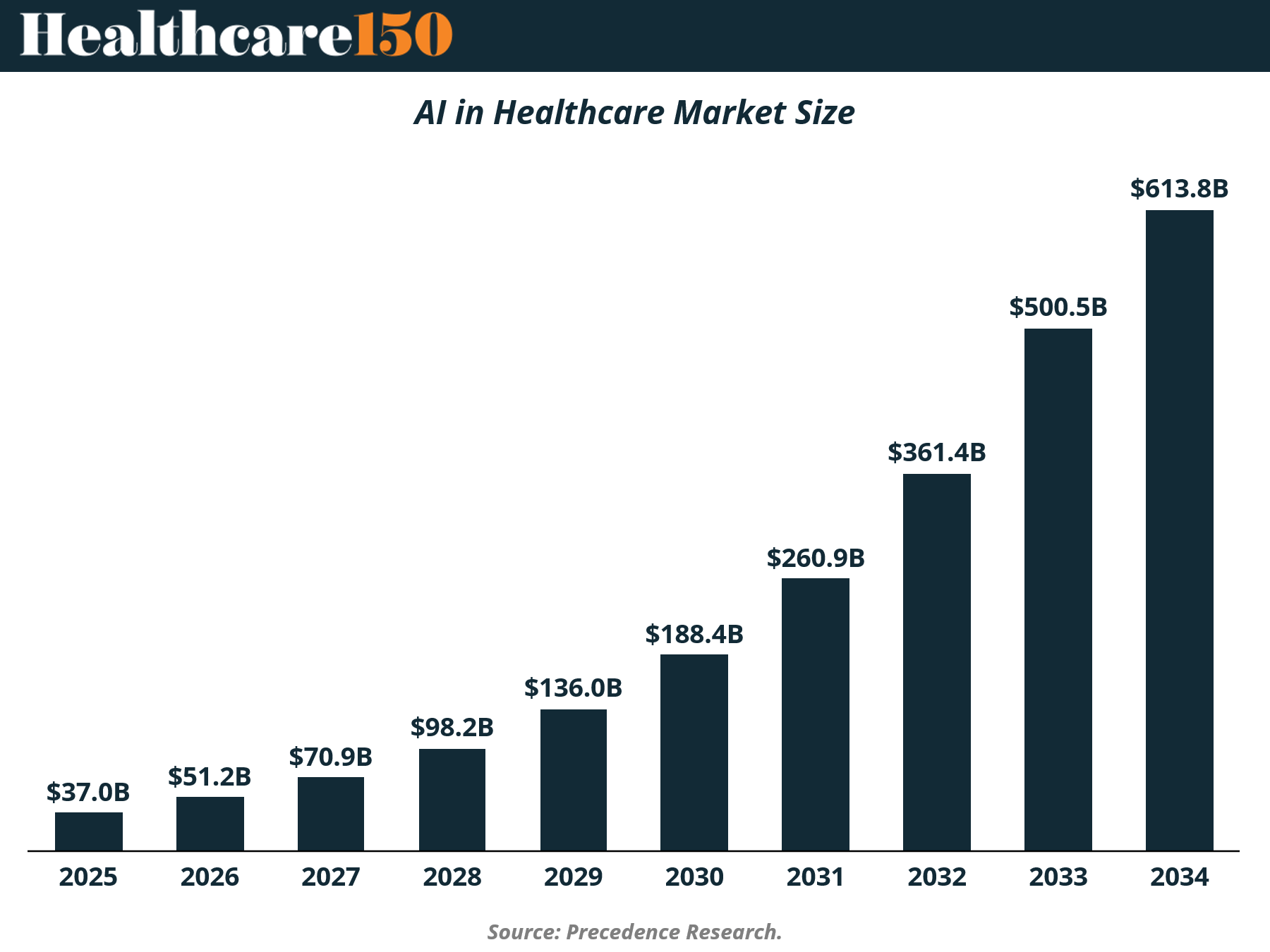
Between 2025 and 2029, the market expands steadily, crossing $100B by 2028. But the real inflection point occurs post-2030, where adoption, infrastructure, and investment converge. In just four years, the market scales from ~$188B in 2030 to over $600B by 2034, highlighting a shift from early adoption to mass deployment across healthcare systems.
Three forces are driving this acceleration:
Data scale and accessibility: The explosion of clinical, imaging, and patient-generated data is creating the foundation AI models require to deliver meaningful outcomes.
Operational pressure: Health systems facing workforce shortages and rising costs are increasingly turning to AI as a productivity multiplier, not just a tool.
Maturing AI capabilities: Advances in generative AI, diagnostics, and decision support are pushing AI from back-office optimization into core clinical workflows.
What makes this market particularly compelling is that it is broad-based. Growth is not concentrated in a single segment but spans MedTech, digital health, pharma, and care delivery, reinforcing the idea that AI is becoming a horizontal layer across the entire healthcare ecosystem.
For investors and operators, the implication is clear:
AI in healthcare is transitioning from a high-growth niche to a foundational, multi-hundred-billion-dollar market—with the steepest value creation still ahead.
Key drivers of growth in the AI healthcare market
The rapid expansion of artificial intelligence in healthcare is underpinned by several fundamental factors that are reshaping the industry and driving unprecedented market growth.
Exponential increase in healthcare data:
The volume of healthcare data continues to grow at an extraordinary rate, with global data volumes estimated to exceed 175 zettabytes by 2025. This surge is fueled by the widespread adoption of electronic health records, medical imaging, wearable devices, and genomic sequencing. AI technologies are uniquely positioned to manage, analyze, and extract actionable insights from this vast and complex data pool, enabling more accurate diagnostics, predictive analytics, and personalized treatment planning.Rising demand for personalized medicine:
There is a growing expectation among patients and providers for tailored treatment plans that consider individual genetic, lifestyle, and clinical factors. AI’s ability to process and synthesize large, diverse datasets supports the development of precision medicine, which is rapidly becoming a strategic priority for healthcare organizations worldwide.Need for enhanced efficiency and cost reduction:
Healthcare systems are under increasing pressure to deliver high-quality care while controlling costs. AI-driven automation, predictive analytics, and workflow optimization help reduce operational expenses, streamline administrative processes, and improve resource allocation. The return on investment for AI in healthcare is compelling, with studies showing that healthcare organizations realize a positive ROI within 14 months, generating $3.20 for every $1 invested in AI.Improved patient outcomes:
AI-powered diagnostic tools and decision support systems are enhancing the accuracy and speed of disease detection and treatment planning. For example, AI algorithms have demonstrated the ability to match or exceed expert clinician performance in certain diagnostic tasks, leading to earlier interventions, reduced errors, and better overall patient outcomes.Shortage of healthcare professionals:
The global healthcare workforce is facing significant shortages, with estimates suggesting a deficit of 10 million health workers by 2030. AI and machine learning technologies are being adopted to augment clinical staff, automate routine tasks, and support rapid diagnosis and treatment planning, thereby helping to bridge gaps in care delivery.Advancements in AI and digital health technologies:
Ongoing innovations in machine learning, big data analytics, and digital health platforms are expanding the range of AI applications in healthcare. These include medical imaging analysis, drug discovery, clinical trial optimization, remote patient monitoring, and robotic-assisted surgery.Government initiatives and investment:
Supportive regulatory environments, government funding, and public-private partnerships are accelerating the adoption of AI in healthcare. Increased funding for research and development, as well as industry collaborations, are further driving market expansion.
III. AI in Healthcare Market Share by Region
The global AI in healthcare market is characterized by strong regional disparities in adoption, investment, and growth potential. Understanding these regional dynamics is essential for stakeholders seeking to navigate the evolving landscape of digital health.
North America
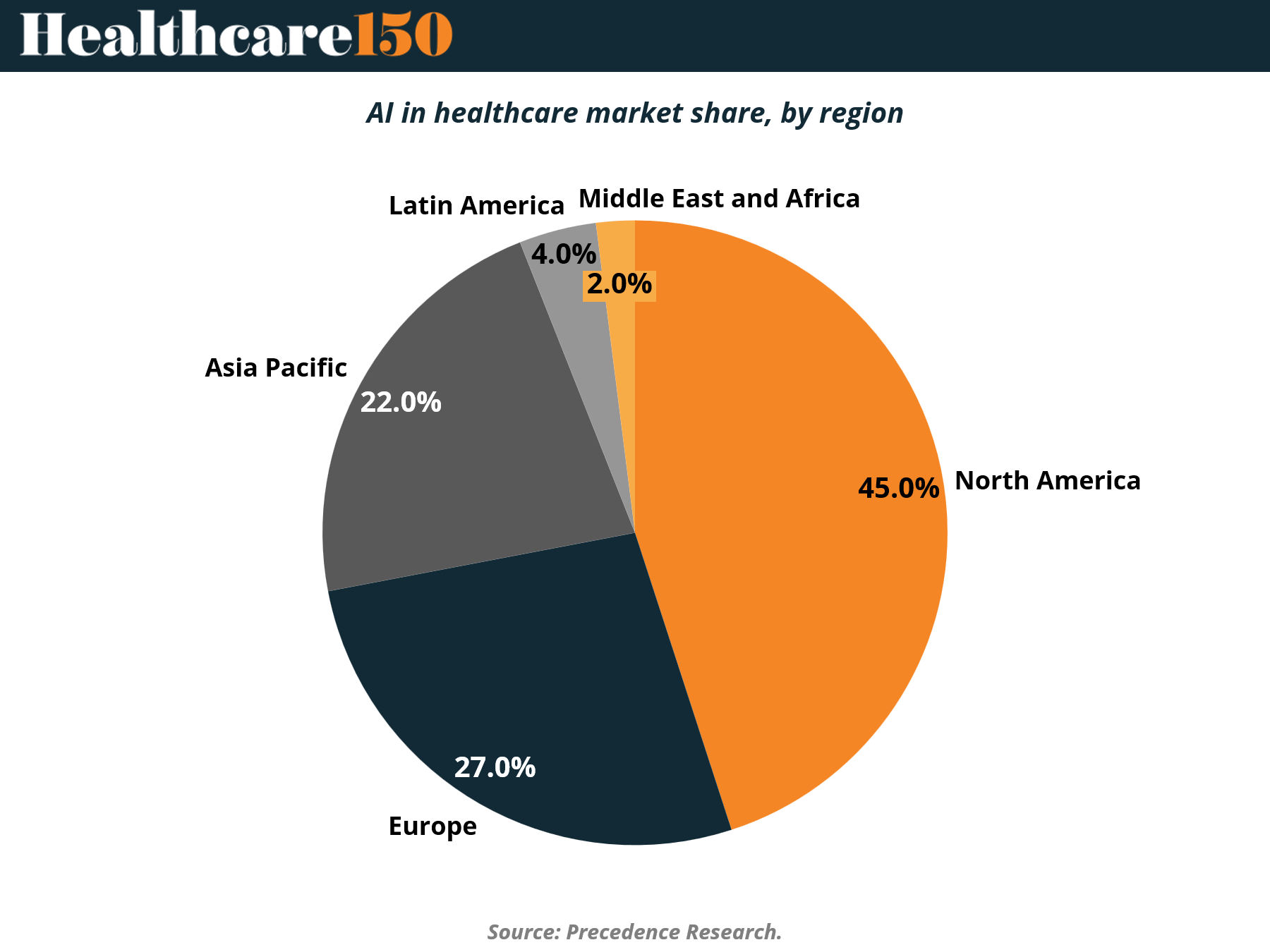
North America remains the dominant region in the global AI in healthcare market, generating over 45% of worldwide revenue in 2024. The U.S. is the largest single contributor, with the market valued at USD 8.41 billion in 2024 and projected to reach approximately USD 195.01 billion by 2034, reflecting a compound annual growth rate of 36.94% from 2025 to 2034. This leadership is underpinned by advanced healthcare and IT infrastructure, robust investment from major technology and healthcare companies, and a regulatory environment that encourages innovation. The region also benefits from a large patient population, with a significant proportion suffering from chronic diseases, which drives demand for AI-powered data management and decision support systems.
Asia-Pacific
Asia-Pacific is the fastest-growing region for AI in healthcare, with a high CAGR expected throughout the forecast period. Growth is driven by substantial government investments in smart hospitals and digital health initiatives, expanding IT infrastructure, and a rapidly increasing patient population. The widespread adoption of smartphones and internet connectivity further accelerates the integration of AI technologies. China holds the largest market share within Asia-Pacific, supported by strong government initiatives and partnerships between hospitals and leading technology firms. The region's large and aging population, coupled with rising rates of lifestyle-related diseases, is fostering robust demand for AI-driven healthcare solutions.
Europe
Europe holds a significant share of the global market and is anticipated to remain the second-most dominant region after North America. The United Kingdom leads in Europe, with the National Health Service (NHS) actively exploring AI applications in medical imaging, predictive analytics, and personalized medicine. Supportive government policies and the presence of leading pharmaceutical and biotechnology companies are further accelerating the adoption of AI for drug discovery, diagnostics, and hospital management.
Latin America, Middle East & Africa
Latin America and the Middle East & Africa regions currently account for a smaller share of the global market but are expected to experience steady growth as digital health initiatives gain momentum. Investments in healthcare IT infrastructure and increasing awareness of AI’s potential are driving adoption, albeit at a slower pace compared to North America and Asia-Pacific.
IV. Generative AI in healthcare market
Generative AI in Healthcare: From Experimentation to Core Infrastructure
Generative AI is rapidly transitioning from a pilot-phase technology to a foundational layer within healthcare systems—and the market trajectory reflects that shift.

According to the latest data, the global generative AI healthcare market is projected to grow from $2.6B in 2025 to nearly $40B by 2034, representing a ~35%+ CAGR over the period. Growth accelerates meaningfully post-2029, with the market more than tripling from $11.9B in 2030 to $39.7B by 2034, signaling a shift from early adoption to scaled deployment.
This inflection is not just about technology maturity—it’s about use-case validation.
Early investments were concentrated in low-risk, high-efficiency applications like:
Clinical documentation and ambient scribing
Patient communication and engagement
Administrative workflow automation
But the next wave of growth is being driven by higher-value, decision-adjacent use cases, including:
AI-assisted diagnostics and imaging interpretation
Drug discovery and clinical trial design
Personalized treatment planning
What’s critical is that adoption is no longer being led by innovation teams—it’s increasingly owned by operations, finance, and clinical leadership, where ROI is measurable.
At the same time, the steep growth curve reflects rising confidence in model reliability, regulatory clarity, and data infrastructure readiness. As health systems move from fragmented pilots to integrated AI stacks, generative AI is becoming embedded directly into EHRs, care pathways, and payer workflows.
Bottom line: The market is not just expanding—it’s compounding on proven value. By the early 2030s, generative AI won’t be a differentiator in healthcare. It will be part of the baseline operating model.
V. AI Adoption Is Moving from Experimentation to Core Infrastructure
AI in healthcare is entering a decisive scale phase. While adoption today remains relatively limited—addressing less than 15% of the global healthcare market—the trajectory is clear: penetration is expected to surpass 30% by 2030, signaling a transition from isolated use cases to system-wide integration.

What stands out is not just the growth, but where adoption is accelerating fastest.
By 2030, MedTech is expected to lead with ~45% AI adoption, driven by imaging, diagnostics, and device-enabled analytics. Close behind, consumer health, digital health, and healthcare services are each projected to reach ~40%, reflecting the rapid digitization of patient engagement, remote care, and operational workflows.
Meanwhile, more traditional or regulated segments—pharmaceuticals (~35%), payers (~30%), pharmacies (~30%), and inpatient/outpatient care (~30%)—are scaling more gradually. This lag is less about lack of value and more about complex regulatory environments, data fragmentation, and integration challenges with legacy systems.
The implication is clear: AI adoption will not be uniform across the healthcare ecosystem. Instead, it will follow a capability-first path, with segments that are more digital, data-rich, and consumer-facing moving faster.
For operators and investors, this creates a two-speed market:
High-adoption segments where AI is becoming a competitive necessity
Lagging segments where early movers can still capture disproportionate value
Ultimately, the next five years will define whether AI remains a productivity layer—or becomes the foundational infrastructure of modern healthcare delivery.
VI. Challenges and Risks of Artificial Intelligence in Healthcare
The integration of artificial intelligence into healthcare systems offers immense promise for improving clinical outcomes, operational efficiency, and patient experiences. However, the widespread adoption of AI technologies also introduces significant challenges and risks that must be carefully managed to ensure patient safety, regulatory compliance, and ethical integrity.
Data Privacy and Cybersecurity
AI systems in healthcare require access to vast amounts of sensitive patient data, including electronic health records, medical imaging, and genetic information. This reliance on personal and often highly confidential data exposes healthcare organizations to heightened risks of data breaches, unauthorized access, and cyberattacks. Ensuring robust data encryption, secure access controls, and comprehensive incident response protocols is essential to protect patient privacy and maintain trust in digital health solutions.
Regulatory and Compliance Complexity
The regulatory landscape for AI in healthcare is rapidly evolving, with stringent requirements for data protection, algorithmic transparency, and clinical validation. Organizations must navigate a complex web of local, national, and international regulations, such as HIPAA in the United States and GDPR in Europe. The absence of harmonized standards and the emergence of new guidelines for AI in clinical practice create operational and legal challenges, particularly for organizations operating across multiple jurisdictions.
Algorithmic Transparency and Explainability
Many AI models, especially those based on deep learning, function as “black boxes,” making it difficult for clinicians and patients to understand how decisions are derived. This lack of transparency can undermine trust in AI-driven recommendations and complicate accountability in cases of adverse outcomes. Ensuring explainability and interpretability of AI systems is critical for fostering clinician confidence and facilitating regulatory approval.
Bias and Equity Considerations
AI algorithms can inadvertently perpetuate or amplify biases present in training data, leading to disparities in care delivery and outcomes for underrepresented or marginalized patient groups. Rigorous testing for bias, ongoing monitoring of algorithmic performance, and the inclusion of diverse datasets are essential to promote fairness and equity in AI applications.
Interoperability and Integration
The successful deployment of AI solutions often depends on seamless integration with existing healthcare IT infrastructure. Challenges related to data interoperability, system compatibility, and workflow adaptation can hinder the effective implementation of AI tools. Addressing these technical barriers requires standardized data formats, collaborative partnerships, and scalable IT architectures.
Workforce Readiness and Training
The adoption of AI in healthcare necessitates a workforce that is proficient in both clinical and digital competencies. Clinicians and support staff must be adequately trained to use AI tools effectively, interpret their outputs, and integrate them into routine practice. Resistance to change, digital literacy gaps, and the need for continuous education present ongoing challenges for organizations seeking to harness the full potential of AI.
Ethical and Legal Responsibility
The use of AI in clinical decision-making raises important ethical questions regarding accountability, liability, and the role of human oversight. Establishing clear governance frameworks, ethical guidelines, and mechanisms for redress is essential to ensure that AI is used responsibly and in the best interests of patients.
VII. Conclusion
Artificial intelligence is redefining the economics and capabilities of healthcare at a pace that few other technologies have achieved. What is unfolding is not a single wave of innovation, but a system-wide transformation—one that spans clinical care, operations, research, and patient engagement.
The evidence is clear. Market growth is accelerating toward a multi-hundred-billion-dollar scale, generative AI is unlocking new high-value use cases, and adoption is expanding across every segment of the healthcare ecosystem. At the same time, the shift from experimentation to deployment signals a critical inflection point: AI is no longer optional—it is becoming core infrastructure.
However, the path forward will not be uniform. Differences in regulation, data maturity, and organizational readiness will continue to create a two-speed market, where some players scale rapidly while others lag behind. Success will depend not only on technological investment, but on the ability to integrate AI into workflows, align it with clinical and financial outcomes, and build trust among providers and patients.
Equally important, the risks associated with AI—ranging from data privacy and cybersecurity to bias and accountability—will require robust governance frameworks and cross-industry collaboration. Organizations that fail to address these challenges proactively risk slowing adoption or eroding trust, while those that do will establish a durable competitive advantage.
Looking ahead, AI’s role in healthcare will extend far beyond efficiency gains. It will reshape how care is delivered, how decisions are made, and how value is created across the system. In this next phase, the leaders will not be those experimenting with AI—but those operationalizing it at scale.
In that sense, AI is not just transforming healthcare—it is redefining its foundation.
Sources and References:
AI healthcare market forecast to 2034
AI’s potential in healthcare
Market analysis of generative AI in healthcare
Market trends and growth drivers of generative AI in healthcare
Overview of global AI healthcare market
Role and impact of AI systems in improving healthcare outcomes