- Healthcare 150
- Posts
- A $160M Bet on AI-Powered Cardiac Care
A $160M Bet on AI-Powered Cardiac Care
Pediatric healthcare is becoming a more complex investment market.

Santiago Morazzani
November 10, 2026
Sponsored by


Good morning, ! This week we’re diving into pediatric healthcare’s $32.5B growth opportunity, the geographic inequalities shaping children’s health outcomes, and Laza Medical’s $160M financing to advance AI-powered robotic cardiac imaging.
Want to advertise in Healthcare 150? Check out our ad platform, here.
Know someone in the healthcare space who should see this? Forward it their way. Here’s the link.
— The Healthcare150 Team

DATA DIVE
Pediatric Healthcare’s $32.5B Opportunity: Growth Meets Geographic Inequality
Pediatric healthcare is becoming a more complex investment market. The sector covered by Precedence Research’s forecast is projected to grow from $15.8B in 2025 to $32.5B by 2034, representing an 8.3% CAGR. But the real opportunity lies in addressing the structural inefficiencies behind rising demand.
Geography is a major fault line. 17.5% of U.S. children live in rural areas, where obesity affects 20.2% of children aged 6 to 17, compared with 16.4% in non-rural communities. Despite higher reported physical activity, rural children also exhibit greater sugary beverage consumption, highlighting the limitations of conventional prevention strategies.

The cost implications are equally significant. A study of 652,297 children in Chile found that privately insured children aged 5 to 6 with low BMI incurred 57.8% higher annual healthcare expenditure than their normal BMI peers. The findings underscore how nutritional conditions can reshape pediatric healthcare economics, although they cannot be directly extrapolated to the U.S.
Bottom line: For investors and operators, the opportunity is not simply expanding pediatric capacity. It is building integrated, financially sustainable care models that combine prevention, behavioral health, and rural access while demonstrating measurable clinical and economic returns.

COMPANY OF THE WEEK
Laza Medical
Laza Medical is taking aim at a critical part of cardiac care: the imaging that guides physicians through complex interventions. On November 4, 2026, the Los Gatos, California-based company announced up to $160 million in Series B structured financing, led by GE HealthCare, with returning investors Unorthodox Ventures, PA MedTech, and AMED participating.
A privately held Shifamed portfolio company, Laza is developing an AI-powered robotic imaging system designed to simplify procedures in cardiac catheterization labs and reduce reliance on scarce specialized imaging expertise. The opportunity is to make image guidance more consistent today while laying the groundwork for future robotic-enabled interventions.
Why it stands out: substantial financing and backing from a major medical-imaging company give this lesser-known developer a compelling milestone. Its progress is worth watching as hospitals seek ways to manage increasingly complex cardiac procedures with constrained specialist resources.
The important distinction: this is a financing milestone, not a regulatory approval or proof of better patient outcomes. The announced amount is up to $160 million in structured financing, not confirmation that the full amount has been received. The Laza Medical System remains under development and is not approved for commercial sale in any geography. (More)
Finally, a Monday that doesn’t feel like one.

Imagine a Saturday where you're not catching up on the CRM you didn't touch all week.
HubSpot's new self-updating CRM doesn't wait for you to log back in. Friday's calls are already logged. The deal that needs a nudge Monday morning is already flagged. The automation you set up once keeps running without you thinking about it. None of it needed you over the weekend.
Customers are already seeing it pay off: 45% more deals closed. Finally, you start Monday caught up, not behind.

TREND OF THE WEEK
Pharma’s Inflection Is About Execution
Over the past five years, pharma and life sciences have faced a persistent challenge: translating scientific innovation into shareholder returns. The sector generated 5.8% annualized TSR, significantly trailing the S&P 500’s 10.5%. Despite accelerating drug approvals and technological breakthroughs, investor sentiment remained cautious. However, Q4 2025 signaled a potential turning point, with pharma delivering 10.7% TSR, compared with just 1.4% for the broader market. While one strong quarter does not establish a sustained recovery, it suggests a possible shift in market expectations.
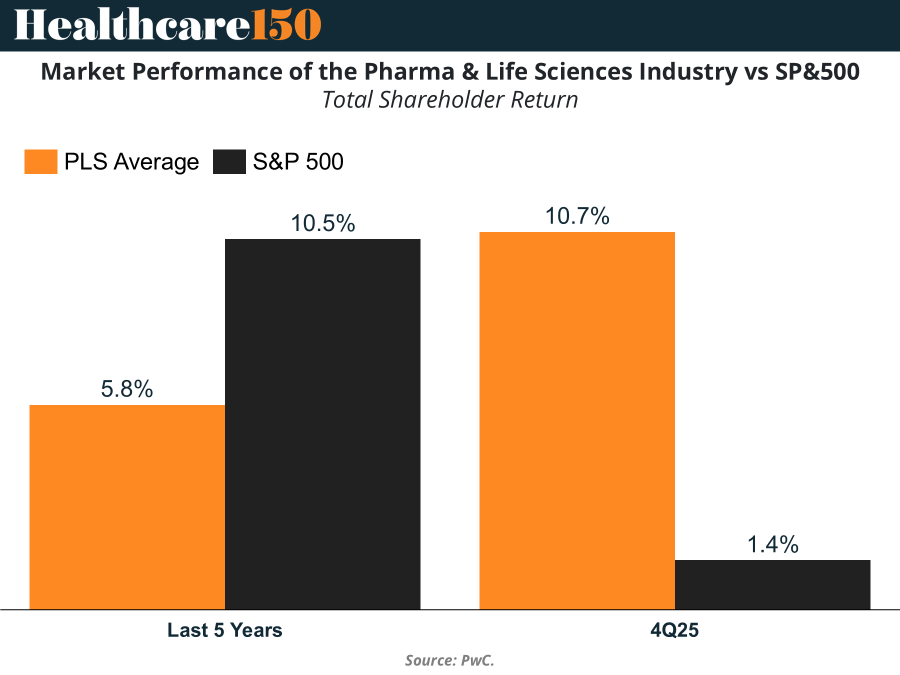
The industry's transformation extends beyond scientific progress. AI-driven drug discovery, precision medicine, and therapeutic innovation beyond GLP-1s are creating opportunities to improve development efficiency and expand treatment options. Meanwhile, U.S. healthcare spending exceeding $5 trillion is intensifying pressure to demonstrate measurable clinical and economic value.
The takeaway: The next phase of pharmaceutical growth will depend on more than breakthrough treatments. Companies that combine scientific innovation, disciplined capital allocation, operational efficiency, and patient-centered commercialization strategies will be better positioned to translate technological progress into sustainable financial performance. (More)